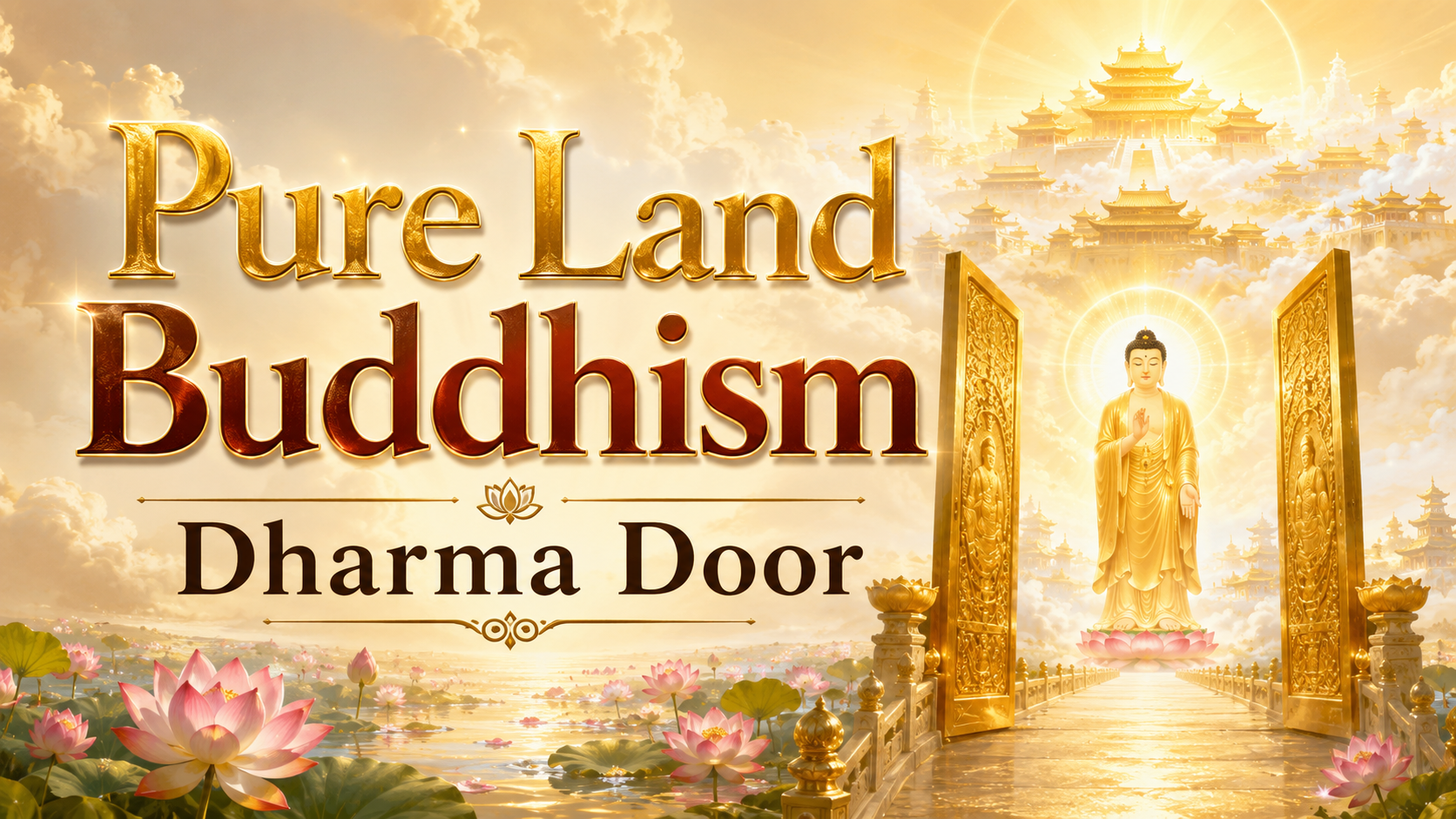
Pure Land Buddhism Dharma Door: The Easy and Simple Path to the Land of Ultimate Bliss
Introduction
Throughout history, the Buddha taught many different methods of practice to help living beings attain liberation from suffering. These methods are known as Dharma Doors. Just as a large building has many doors leading inside, Buddhism has many paths leading toward the same ultimate goal—the end of suffering and the attainment of enlightenment.
Some Dharma Doors emphasize deep meditation. Others focus on wisdom, moral discipline, or the understanding of profound Buddhist teachings. Every Dharma Door is precious because each is suitable for people with different abilities, circumstances, and personalities.
Among all these paths, Pure Land Buddhism has become one of the most widely practiced because it offers an easy, simple, direct, and compassionate way for ordinary people to escape the endless cycle of birth and death.
Some well-known Dharma Doors include:
- Zen (Chan) Buddhism – emphasizes meditation and directly realizing one’s true nature.
- Theravada Practice – emphasizes morality, meditation, mindfulness, and wisdom to attain Arhatship.
- Tiantai School – emphasizes the Lotus Sutra and comprehensive Buddhist practice.
- Huayan School – emphasizes understanding the interconnected nature of all phenomena.
- Vajrayana (Esoteric Buddhism) – uses mantra, visualization, mudras, and advanced practices under the guidance of a qualified teacher.
- Pure Land Buddhism – emphasizes faith, aspiration, and recitation of Amitabha Buddha’s name to attain rebirth in the Western Pure Land.
Every Dharma Door taught by the Buddha is valuable. The important thing is choosing the method that matches one’s abilities and practicing it sincerely.
What Is Pure Land Buddhism?
Pure Land Buddhism is based on the great compassion and vows of Amitabha Buddha.
Long ago, before becoming a Buddha, Amitabha made forty-eight great vows. His greatest wish was to establish a pure land where beings could practice Buddhism without the countless difficulties found in our world.
After countless ages of cultivation, he fulfilled these vows and established the Western Pure Land of Ultimate Bliss.
Pure Land Buddhism teaches that anyone who sincerely:
- Has faith in Amitabha Buddha,
- Wishes to be reborn in the Western Pure Land,
- And recites Amitabha Buddha’s name,
can receive Amitabha Buddha’s compassionate guidance at the end of life and be reborn in his Pure Land.
The practice is often called Amitabha-recitation, simply reciting:
“Namo Amitabha Buddha.”
This easy and simple practice has been followed by millions of Buddhists for over a thousand years.
What Makes Pure Land Buddhism Special?
Many Buddhist paths require practitioners to gradually eliminate greed, anger, ignorance, and countless mental afflictions while living in this difficult world.
Our world is filled with distractions, desires, illness, aging, family responsibilities, financial pressures, and countless obstacles. Even sincere practitioners may find it difficult to maintain steady progress throughout life.
Pure Land Buddhism offers a compassionate alternative.
Instead of relying entirely upon one’s own strength, practitioners rely upon both their own sincere practice and the compassionate vows of Amitabha Buddha.
This combination makes the path especially suitable for ordinary people living in the modern world.
Its practice is also remarkably simple.
One does not need advanced meditation abilities, profound philosophical understanding, or extraordinary spiritual experiences.
Anyone—young or old, educated or uneducated, wealthy or poor, monk or lay follower—can sincerely recite Amitabha Buddha’s name.
What Is the Western Pure Land of Ultimate Bliss?
The Western Pure Land of Ultimate Bliss is the pure Buddha-land established by Amitabha Buddha.
It is not part of our ordinary world.
According to the Pure Land Sutras, it is a realm completely free from suffering.
There is:
- No war.
- No hunger.
- No sickness.
- No aging.
- No fear.
- No hatred.
- No greed.
- No rebirth into the lower realms.
Everything there supports Buddhist practice.
The land is described as being adorned with:
- Golden ground,
- Crystal-clear ponds filled with water possessing eight excellent qualities,
- Lotus flowers of many wonderful colors,
- Jeweled trees,
- Beautiful pavilions,
- Gentle breezes,
- Birds that naturally proclaim the Dharma,
- Heavenly music,
- Fragrant flowers that fall from the sky,
- Brilliant light illuminating the entire land.
The environment itself constantly reminds beings to cultivate wisdom, compassion, and mindfulness.
There are no distractions leading people away from practice.
Every day, practitioners listen to the Dharma taught by Amitabha Buddha and numerous Bodhisattvas, continually advancing toward complete enlightenment.
How Can One Be Reborn in the Western Pure Land?
Pure Land Buddhism emphasizes three essential principles:
Faith
Believe in Amitabha Buddha’s great vows and believe that rebirth in the Western Pure Land is possible.
Aspiration
Wholeheartedly wish to be reborn in the Western Pure Land after this life.
Practice
Consistently recite Amitabha Buddha’s name with sincerity and mindfulness.
The more sincere one’s faith and aspiration, the more stable one’s practice becomes.
Throughout life, practitioners also cultivate good deeds, keep moral conduct, develop compassion, and dedicate all merits toward rebirth in the Pure Land.
According to the Pure Land Sutras, when the end of life arrives, Amitabha Buddha, together with the Bodhisattvas Avalokitesvara (Guan Yin Pusa) and Mahasthamaprapta (Da Shi Zhi Pusa), appears before sincere practitioners and brings them to the Western Pure Land.
Records of Pure Land Sages (Jingtu Shengxian Lu, 淨土聖賢錄)
Throughout the long history of Pure Land Buddhism, countless practitioners have devoted their lives to reciting Amitabha Buddha’s name.
Many of them left behind remarkable accounts describing peaceful deaths, visions of Amitabha Buddha, and signs traditionally understood within the Pure Land tradition as indications of successful rebirth in the Western Pure Land.
Records of Pure Land Sages is a remarkable collection preserving these historical accounts.
The book contains more than one thousand real-life stories of monks, nuns, lay followers, government officials, scholars, farmers, merchants, and ordinary people who devoted themselves to Pure Land practice.
These accounts span many centuries and demonstrate that Pure Land practice is not limited to a particular social class, education level, or occupation. People from every walk of life sincerely practiced Amitabha-recitation and left inspiring examples for future generations.
Rather than presenting philosophical theories alone, the book shows how Pure Land Buddhism has been practiced in everyday life. Readers will encounter stories of unwavering faith, perseverance through hardship, compassionate conduct, and peaceful departures at the end of life that have inspired Pure Land practitioners for generations.
Whether someone is completely new to Pure Land Buddhism or has practiced for many years, Records of Pure Land Sages offers encouragement and confidence that sincere practice is possible for ordinary people living ordinary lives.
It reminds us that the path taught by Amitabha Buddha has been walked by countless practitioners before us, and that with sincere faith, deep aspiration, and steady recitation of Amitabha Buddha’s name, we too can aspire to be reborn in the Western Pure Land of Ultimate Bliss.
If you want to read or download the entire eBook, Records of Pure Land Sages, you may click here.
……………………………………